



Untapped environmental potential in the life cycle assessments of sustainable buildings


Proposed method – consideration of longlasting construction materials in the building LCA
1 Summary
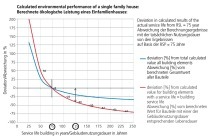
The life cycle assessment of buildings in German systems is usually carried out over a fixed reference study period (RSP) of 50 years. However, this does not consider the actual technical service life of durable building materials such as bricks and roof tiles, which are often used for much longer than this. The proposed method presents a “longevity bonus”, which enables the durability of bricks and roof tiles to be taken into account in the building life cycle assessment in accordance with applicable standards. The “longevity bonus” is based on DIN EN 15978 and enables a differentiated assessment through the introduction of a correction factor. This correction factor adjusts the global warming potential (GWP) of buildings to reflect the actual service life of durable components without changing the existing 50 years as the standard reference study period (RSP). The proposed approach uses an “opening clause” that only includes components with a proven influence on the durability of a building in the calculation and integrates these adjustments into existing assessment standards. The study commissioned by the Association of the German Brick and Tile Industry works out how to calculate the correction factor and shows the practical application of the model using a real brick building for the exemplary calculation. This method enables a more accurate representation of the long-term environmental benefits of durable building materials and contributes to a more realistic environmental assessment of buildings. The proposal thus offers valuable guidance regarding sustainable construction and resource conservation in the context of the circular economy (»Figure 1).
This technical paper is an abbreviated version of the article of the same name in the “Mauerwerk-Kalender 2027” ([1] Schermer et al. 2027), which is due to be published in 2027.
2 Ecological potential of brick- and roof tile-constructions
The durability of bricks and roof tiles as building material is undisputed. Surveys based on empirical values indicate a possible service life of over 100 years for brick-build residential buildings, and the existing housing stock also demonstrates their durability, ([2] Holm et al. 2024). This results in a significant sustainability aspect, which also represents an ecological advantage.
In addition to durability of the main construction material in a building, there are many other aspects that also have a great impact on its sustainability. For bricks and roof tiles, which are in the focus of the following discussion, the most important of these aspects can be summarized as follows (not exhaustive):
good strength and load-bearing capacity
high sound insulation
durability and robustness for any use
high heat storage capacity, i.e. heat is absorbed and released over the time
high porosity / low thermal conductivity: possibility of monolithic / single-shell construction, i.e. no additional insulation layer is necessary, only plaster; good thermal insulation with sufficient strength for limited static requirements
non-combustible
sturdy / damage- and climate-resistant
moisture regulation and associated positive effect on the indoor climate and healthy living
high potential for recycling and reuse, which is already being implemented in existing manufacturing and demolition processes today, ([3] Muchow et. al. 2024)
Although all these properties contribute to the longevity of a building, they are not adequately taken into account in the current calculation methods for the LCA.
In German sustainable building assessment systems such as BNB (Assessment System for Sustainable Building) and DGNB (German Sustainable Building Council), a shortened reference study period (RSP) of 50 years is applied, this fact also applies to the QNG (Sustainable Building Certification) approach for new building subsidies in Germany. However, this standardized RSP often does not correspond to the actual service life of durable components and structures. Particularly in the case of solid structures – such as those made of brick or concrete – this means that a significant portion of the actual lifespan does not influence the life-cycle GWP. The associated residual value of these components is not reflected in the calculation, which distorts the results of the life cycle assessment (LCA). At the same time, load-bearing components with a high mass fraction currently account for a significant proportion of greenhouse gas emissions. Although these components are taken into account as key influencing factors in the LCA in the named assessment systems, the assumed service life remains a flat rate of 50 years regardless of the component type. This contradicts the reality of buildings, where durable structures are often used for many decades, sometimes for over a century, ([2] Holm et al. 2024).
To solve this problem, a DIN EN 15978-compliant approach is needed that allows the service life of durable building structures to be taken into account for calculation within the specified 50-year reference study period for LCA.
3 Development of a proposed method for a “longevity bonus”
Since the DIN EN 15978 standard, which forms the basis for the building life cycle assessment, generally allows for the differentiated inclusion of reference service lives if various requirements and conditions are met, a standard-compliant approach for a longevity bonus represented in the building life cycle assessment can be derived ([4] INTEP, 2025).
In principle, the required (= actual) service life (ReqSL) should be used for this purpose, but longer reference study periods (RSP) are possible with justification.
A life cycle assessment period of 50 years should be assumed (baseline scenario).
The developed method proposes three steps to consider longevity in the life cycle GWP of buildings.
3.1 Relevance (step 1)
The first step in the proposed methodology is to assess the relevance of a construction component to the service life of a building. Relevance is given if the use of the building material has a significant, life-extending influence on the entire building. This is the case, for example, if parts of the supporting structure or essential components of other building elements, such as the exterior facade, benefit from the durability of the materials used. A significant proportion can be demonstrated here, for example, in analogy to the mass balance of a building.
3.2 Opening clause (step 2)
The opening clause regulates the applicability of the proposed standard-compliant method for the life cycle assessment of buildings. Components whose ESL (estimated service life) is significantly longer than the RSP of 50 years are considered. If these meet the conditions of the opening clause, it is possible to include their durability in the life cycle assessment method. This should only apply to building materials whose durability has been proven by technical studies, statistical empirical values or similar. The component-specific correction factor presented in chapter 3.3 is used for this purpose.
Conditions for the opening clause:
The basic requirement is that the expected service life of the components (ESLBT) and thus also the expected service life of the building (ESLG) significantly exceeds the standard reference study period (RSP) of 50 years.
The ESLBT must be specified as the ‘reference service life’ in the environmental product declaration (EPD) of the component in accordance with ISO 14025.
The ESL must be declared in accordance with DIN EN 15804. Verifiable, representative and high-quality data must be available that meets the requirements of Annex E of DIN EN 15804. The data must be sufficient in scope and statistical significance to reliably demonstrate the durability of the building material.
3.3 Correction factor for global warming potential (step 3)
The correction factor is derived from the comparison between the unchanged baseline scenario and the longevity scenario at building level. For the longevity scenario, the RSPL and ELSBT of all components that meet the conditions of the opening clause are adjusted in the life cycle assessment model.
All other components and the use phase of the building remain unchanged and are accounted, based on the currently valid service life table in Germany, ([5] BBSR, 2025). In case that several components with different RSLBT meet the conditions, the longer RSL is used as RSP. This ensures that the correction factor retains the greatest possible significance in terms of durability.
Calculation: The longevity correction factor fL is calculated by using formula 1.
fL = GWPL / GWPB (1)
Within this formular GWPB describes the global warming potential of the building in the baseline scenario in kgCO2-eq/(m²NGF*a) including the modules A1-A3, B6, C3 and C4.
GWPL describes the global warming potential of the building in the longevity scenario in kgCO2-eq/(m²NGF*a) including the modules A1-A3, B6, C3 and C4.
Correction of the baseline scenario
The correction factor fL is applied in accordance with formula 2 to correct the global warming potential of the building in the baseline scenario GWPB to determine the corrected value GWPB,L:
GWPB,L = fL * GWPB (2)
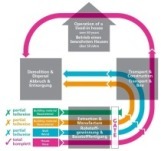
All necessary steps of the proposed method are also shown in »Figure 2.
3.4 Case study
The following case study ([4] INTEP, 2025) illustrates the application of the DIN EN 15978-compliant method for taking into account the longevity of building materials in the building life cycle assessment, using bricks as an example.
For the purposes of this case study, a residential building using monolithic brickwork as main construction, with a flat roof and meeting the EH40 standard, was selected as an example. The useful floor area of this building is 706 m². The correction factor is being examined for the use of a durable load-bearing structure made of clay blocks.
The correction factor is to be determined to represent the longevity of brick components in the building life cycle assessment. The RSLBT is declared as 150 years in accordance with EPD, [6]. This declaration of reference service life in accordance with DIN EN 15804 is further supported by the extensive data on the durability of bricks in German residential buildings, which is already explained in the second Chapter ([2] Holm et al. 2024). This means that the conditions for the application of the opening clause are fulfilled. The entire procedure is summarized in »Figure 3 using the application guide from »Figure 2 and filling in the results from »Table 1.
The life cycle assessment results from the unchanged building model with a 50-year reference study period serve as the baseline scenario. For the longevity scenario, the reference study period (RSP) in the life cycle assessment model is increased to an ESL of 150 years. To do this, the life cycle assessment tool simplifies the service life of the building and the durable building materials under consideration – in this case, brick building materials – to 150 years.
Case study: Calculation of correction factor fL = GWPL / GWPB = 20,60 / 22,43 = 0,919 [ - ]
Based on the method described in this paper, a longevity bonus of 8.1% is achieved for the case study. This bonus - depending on project-specific parameters - is only granted for the given brick construction that has been proven to be durable.
4 Conclusion
The proposed “longevity bonus” method offers a standard-compliant way of taking the longevity of building materials into account in building life cycle assessments. This method can be used as a tool both in the context of new building subsidies in Germany (QNG) and for the implementation of the EPBD at national level (for the amendment of the German Building Modernisation Act). This proposal for a “longevity bonus” will have a meaningful steering effect, which is in line with the national circular economy strategy.