



Economic design of non-load-bearing interior walls for out-of-plane load-bearing capacity under seismic loading
Introduction
Masonry construction is widely used in building construction. In addition to the load-bearing effect in the plane, the out-of-plane load-bearing capacity of non-load-bearing interior walls in particular is decisive for earthquake safety. Existing design approaches provide very conservative, scattered results in some cases and do not sufficiently take into account boundary conditions relevant to construction practice, especially the vertical stiffness at the top of the wall.
Objective
The objective of the project is to further develop a validated engineering model for unconfined masonry walls under seismic loading and to supplement it with essential boundary conditions (slab stiffness, coupling elements, cantilever loads, eccentric supports, vertical earthquake components). At the same time, a practical method for directly determining floor response spectra was developed in order to reduce uncertainty on the impact side.
Approach and results
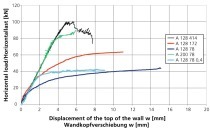
Small component tests as well as pushover and decay tests were carried out experimentally on walls with thicknesses of 80 mm and 115 mm. The measured force-deformation curves correspond very well with the model; the averaged contact stiffness is c = 0.27 1/m, the average damping is approximately 9.2%. A new method for determining floor response spectra was derived from the equation of motion, modally composed, and validated against numerical time history analyses. This provides an easy-to-use, realistic way to determine floor-specific excitations. A validated engineering model for unidirectionally stressed, unreinforced masonry walls under seismic loading was further developed. For decoupled brick interior wall systems, decoupling connection profiles (sound insulation profiles) were mechanically characterized and integrated into the engineering model. Furthermore, console loads were taken into account analytically and dynamically, and eccentric ceiling supports and the vertical earthquake component were modeled.
The existing engineering model is being further developed and supplemented with eccentric ceiling supports. Specifically, this initially concerns the foot supports, where an adjustment of the support surface is necessary. Consequently, the pivot points must also be redefined. The load effect on the head bearing also changes, which means that the calculation of the pivot points must be adjusted. The geometry of the model will be revised accordingly. The eccentric load effect results in additional bending moments, which in turn influence the buckling height of the structure. However, these effects on the buckling height are not being examined in detail as part of the current further development.
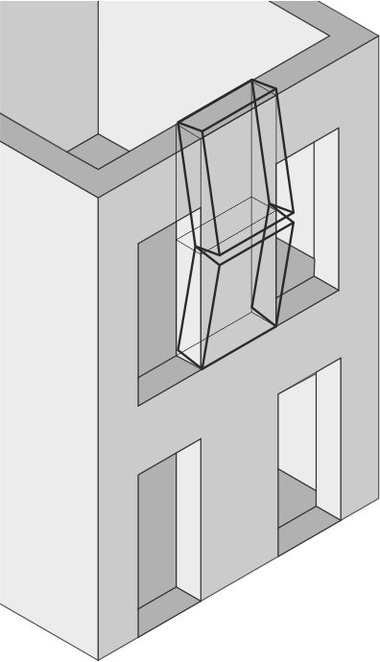
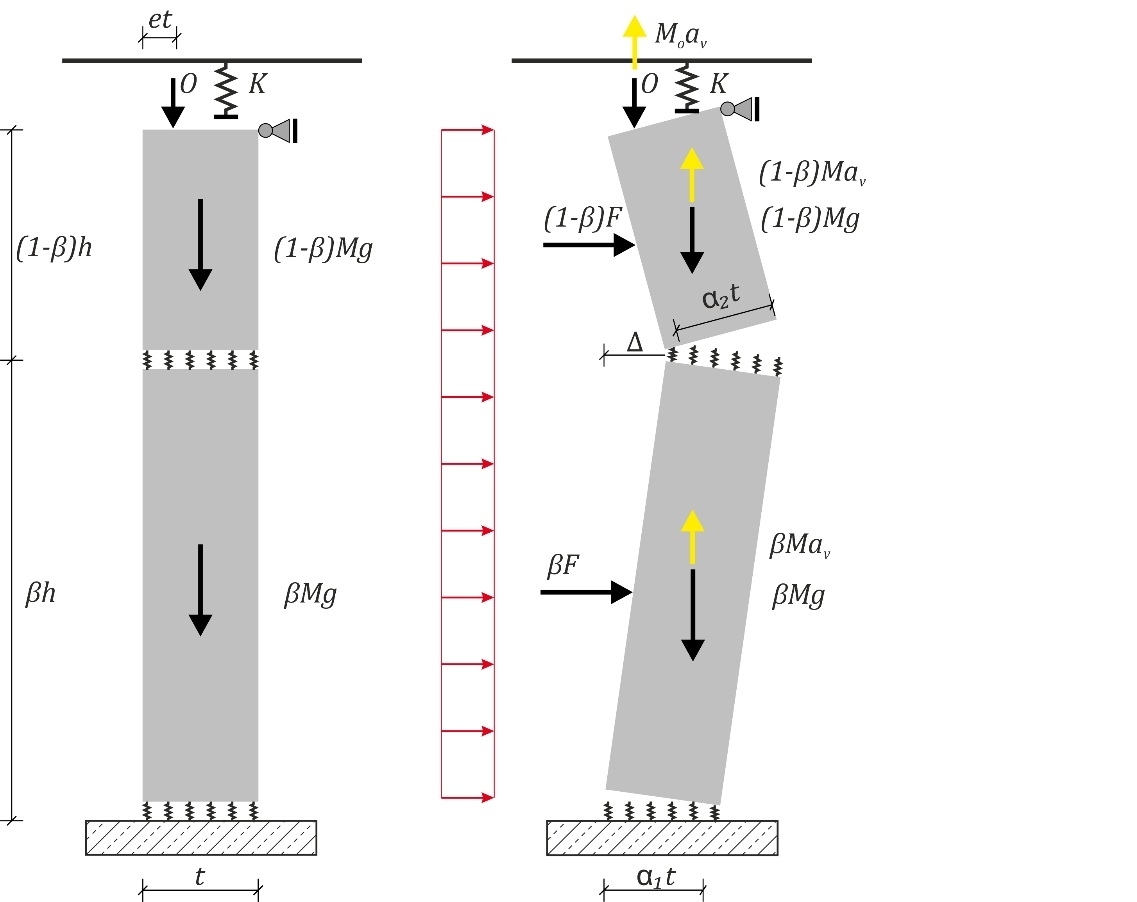
The figure shows the extended analytical model for determining the out-of-plane load-bearing capacity, taking into account the vertical earthquake acceleration.
This is a research project of the Forschungsgemeinschaft der Ziegelindustrie e.V. (FGZ), which was carried out by the Institut für Ziegelforschung Essen e.V. (IZF) and the Rhineland-Palatinate Technical University Kaiserslautern-Landau, Department of Structural Mechanics and Dynamics (SDT). The pre-competitive IGF project 01IF22110 was funded by the Federal Ministry for Economic Affairs and Energy with funds from the IGF.
The objective of the research project was achieved.