



A Look Back at the 29th Conference of Brickwork Museums


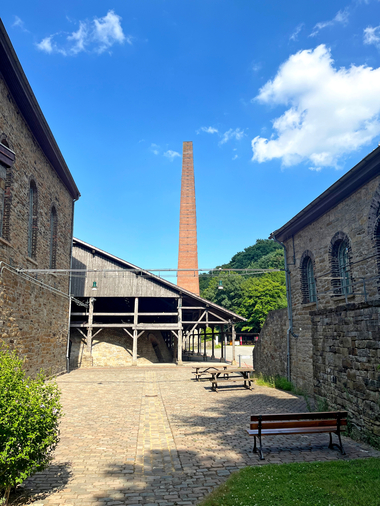
On June 28 and 29 — among the hottest days of the first half of 2026 — the 29th conference of the Brickworks Museums took place. The venue was the LWL Brickworks Museum in Lage, in North Rhine-Westphalia, Germany.
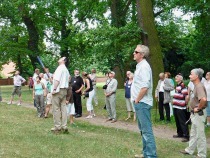
Following a welcome address by museum director Willi Kulke, Sunday’s preliminary program was dedicated to the open-air exhibition on historical brick production at the site. Participants were able to explore the exhibition during a guided tour of the grounds and the historic production facilities. They received detailed explanations of the individual production steps and workstations—including preparation, shaping, open-air drying, and firing in the ring kiln. The museum guide took into account the technical background of most of the audience and shared many interesting details about historical manual and mechanical brick production. Particularly impressive were the descriptions of the hard daily labor not only of the brick setters and fuel hands inside and on top of the ring kiln, but also at the other workstations. The insights into the conditions for the local adoption of mechanized brick production were also fascinating. In addition to the explanations, there were practical demonstrations. Two museum staff members took on the role of brick moulders and demonstrated and explained the shaping of hand-molded bricks. We highly recommend that all readers who have not yet had the pleasure participate in such a guided tour.
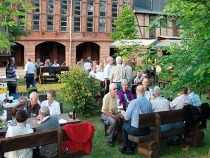
Afterward, the participants gathered for a group dinner, which, as in previous years, provided a good opportunity to make and strengthen connections.
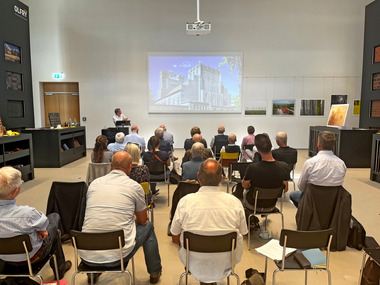
On Monday, the lecture part of the conference took place in the special exhibition hall. The first session was devoted to an explanation of the new permanent exhibition at the Museum Lage (see also ZI 3/26, page 45ff.). Museum Director Kulke presented the permanent exhibition and its long history of development. The decision to create a new permanent exhibition was made in 2020, and the development process leading up to the opening took six years. This was accompanied by a comprehensive reorientation of the museum. The central theme of “bricks” was to be expanded to include the cross-cutting themes of building, housing, architecture, and urban development/community life. Innovative exhibition design techniques, such as gaming, were used to create a low-threshold and entertaining educational approach. Kulke explained the criteria and methods used to develop the new permanent exhibition. A key method in the exhibition’s development was the creation and use of personas to identify the preferences and desires of the most important target groups and tailor the exhibition accordingly. In conclusion, Kulke outlined the next steps: among other things, evaluating the playful educational approach and visitors’ usage behavior, as well as assessing the exhibition’s long-term viability and potential for expansion.
Afterward, participants were invited to explore the exhibition on their own. The museum team was available to answer questions. For the author of this article, the electronic games were particularly appealing. Overall, the participants’ interest—and in some cases, enthusiasm—was evident.
After the games and the subsequent coffee break, Anne Wieland, research specialist for education and outreach, explained how games can be used as a didactic tool for museums. Due to societal changes, visitors’ expectations have shifted. Today, they expect participation, interaction, personalized experiences, and self-directed learning. For museums, this means a shift away from object-centered exhibition spaces toward visitor-oriented spaces for learning and experience. Findings from educational research underscore this approach. For example, games can promote attention, motivation, problem-solving skills, and long-term retention, among other things. Behind the games on offer lie educational principles such as self-efficacy, low barriers to entry, and inclusion. The goal is to enable participation for as many visitor groups as possible. At the end, Wieland discussed the advantages, challenges, and limitations of a playful approach: on the one hand, longer visit durations, more in-depth engagement with content, and appeal to families and school groups; on the other hand, the need to balance play and content, the necessary resources, and the risk of gamification without substance.
The second session after the lunch break was devoted to historical brickworks and historic preservation. Dr. Mathias Austermann, Dortmund’s local historian for the Westphalian Heritage Association, reported in his presentation on archaeological investigations into Westphalia’s medieval brickworks. His interest in this topic arose while he was compiling a catalog of potteries in Westphalia. In the Middle Ages, pottery and brickmaking were usually carried out in the same facility. Using distribution maps of medieval potteries and brickworks, he demonstrated that potteries have only been documented in Westphalia since the 12th century. Brickworks can be traced sporadically only from the 13th century onward and, on a broader scale, only from the 15th and 16th centuries. Most brickworks prior to the 16th century are known only from mentions in written sources. Consequently, our knowledge of their products, activities, and clients is limited. Austermann presented four relatively well-documented examples of late-medieval brickworks and their products in greater detail: the municipal brickworks in Coesfeld, Bochum, and Dortmund, as well as the brickworks of the Cappel Abbey near Lippstadt. However, there are finds of coarse pottery that document the use of building ceramics in Westphalia as early as the 10th century.
In the following presentation, Ernst Buchow, managing director of the Bockhorn clinker brickworks, introduced the Old Clinker centerr located on the brickworks’ grounds. He explained its development since 2014 and the exhibition on the 250-year history of clinker production in the region.
Afterward, members of the board of the Museum Alte Ziegelei Westerholt e. V. presented their museum as well as a current project: the restoration of the drying shed in accordance with historic preservation guidelines. According to their description, the challenges are manifold. In addition to the requirements of historic preservation that must be observed, these challenges include, among other things, the fact that the association does not own the property and does not have the approximately 200,000 euros needed to cover the restoration costs. To address the financing issue, the association’s board members have devised a trust model.
As a break from the lecture program, participants were invited to take a narrow-gauge train ride across the grounds to the former clay pit.
In the final presentation, Tomasz Nieruchalski, Sales and Marketing Director of the Polish brick manufacturer Heritage Roof Tiles Sp. z o.o., introduced the company. Its product range includes an extensive selection of architectural ceramics for renovation purposes, including roof and facade tiles, special formats and shapes, as well as floor tiles and tiles for tiled stoves. Nieruchalski emphasized his company’s individualized approach to every renovation project.
At the conclusion of the conference, the participants discussed the location of next year’s conference and agreed on the Westerholt Brick Museum, following a proposal from its board, .