



‘Courgette ribbons’ hold bricks together – Feldhaus brick slips factory invested in resource-saving bands with the support of WIGOS
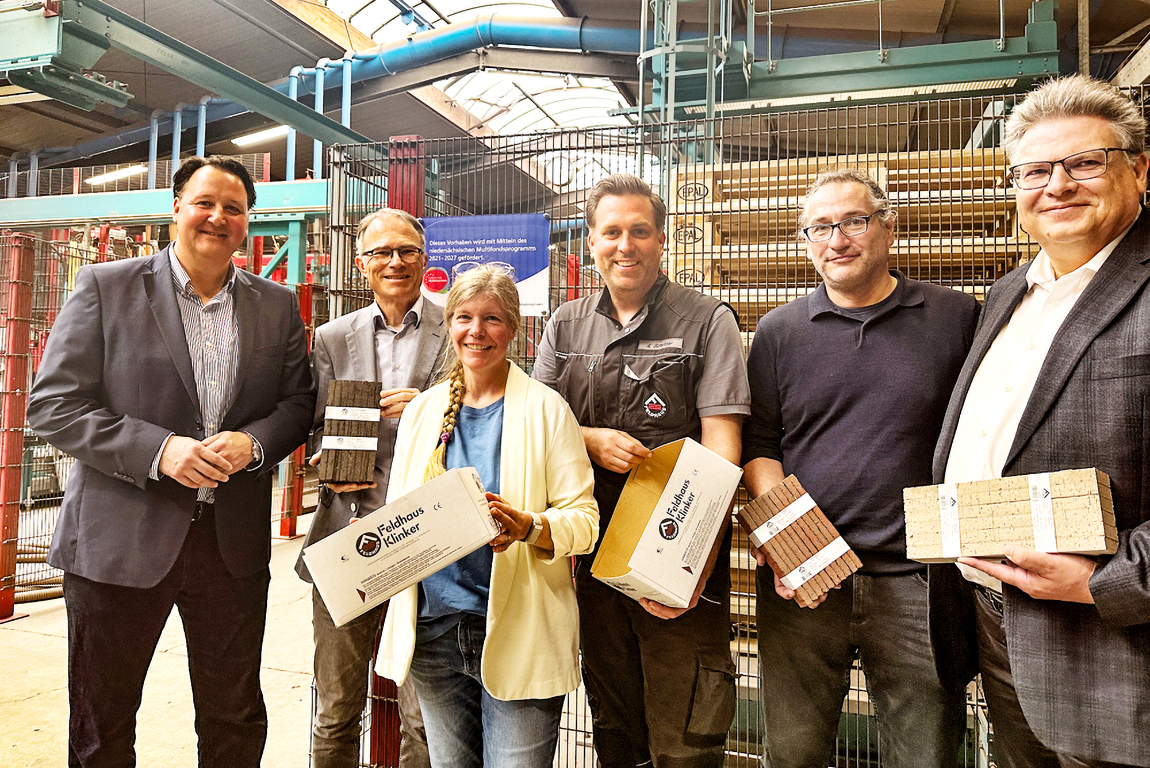
It all started with courgettes: in 2024, while cooking, Alexander Schröder, operations manager at Feldhaus Klinker, was holding the plastic ties used to bundle the courgettes when he had an idea: ‘This is the perfect packaging for our brick slips.’ No sooner said than done – instead of being packed in cardboard boxes, the clinker brick slips will in future be delivered to customers all over the world held together with plastic bands. The resource-efficient optimisation of the flat brick slip packaging was realised with the support of WIGOS and RKW Nord GmbH. They had initiated the funding application for around €650,000 as part of the ‘Resource Efficiency and Circular Economy’ funding programme of the State of Lower Saxony and the European Regional Development Fund (ERDF).
‘It‘s great when such an innovative and sustainable project emerges from such a spontaneous idea,’ says Andrea Frosch from WIGOS Business Services. Ernst Grund, resource efficiency consultant at RKW Nord GmbH, who brought the project idea to approval within a few months, adds: ‘The company simply knew what it wanted.’ Operations manager Alexander Schröder is particularly pleased with how the project has progressed: „WIGOS brought us together with RKW Nord GmbH and got the project off the ground. We worked together efficiently and quickly.“ Lower Saxony‘s Environment Minister Christian Meyer personally presented the positive funding decision to the company management on 14 September 2025.
For the world market leader in brick slip production, this is the largest subsidy that has been approved to date, as Managing Director Ralf Conrad reports. The company is investing a total of €1.9 million in the switch from cardboard packaging to banding. The project is one of many that the long-established company has implemented in the past as part of its energy transition. Step by step, the company is converting its production to be energy-efficient and climate-friendly. ‘Further investments are still pending,’ announces the plant manager.
The existing system for packaging the tiles is currently undergoing extensive conversion and will be supplemented by the banding system. ‘We have many different formats of tiles, which we have previously packaged in cardboard boxes of various sizes, some of them by hand. With the new banding system, we have a uniform packaging material and are completely format-independent,’ explains operations manager Schröder. The result: savings of around 380 tonnes of cardboard and 10 tonnes of polypropylene per year and a reduction of almost 220 tonnes of CO2 per year. From now on, the brick slips will be bundled with plastic banding and shrink-wrapped on a pallet in a weatherproof and stable manner. This will reduce waste. Until now, the cardboard had to be disposed of on the construction site after the bricks had been unpacked.
The advantages convinced the operations manager to convert and upgrade the existing plant accordingly – a very complex undertaking. The plant is currently running in test mode. ‘I am relaxed and confident that the banderole will replace the cardboard,’ emphasises the operations manager at Feldhaus Klinker. In the near future, the brick products will be delivered wrapped in ‘courgette ribbons’ – as Schröder calls the banderoles. ‘We can now give the go-ahead for the banderoling system and inform our customers that we have taken another step in our sustainable strategy towards CO2-neutral production of our products.’