



LINGL SOLEAD on Track
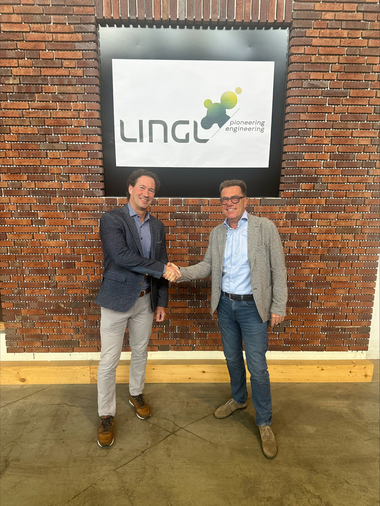
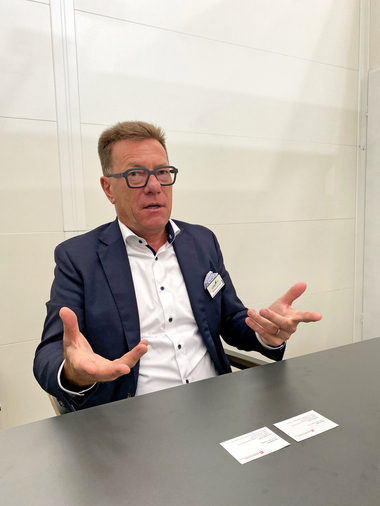
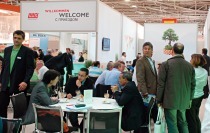
There has been a lot of activity in recent months at the Krumbach-based engineering firm LINGL SOLEAD. Shortly before the Ceramitec trade show in Munich, it was announced that LINGL had signed cooperation agreements with a Dutch and a Turkish company. Changes in the management team were announced at the trade show. The ZI editorial team spoke with the old and new members of the management team – Thomas Weischer, Alexander Schmid, and Hermann Frentzen – about these changes as well as market and technical prospects.
Changes in the Management Team
Mr. Weischer, what changes took place in the management of LINGL SOLEAD as of April 1?
Thomas Weischer (TW): We have appointed a new colleague, Mr. Schmid, to the management team as Chief Financial Officer effective May 1. Almost simultaneously, Mr. Frentzen was recalled from the management team. However, he will remain with the company. He continues to be the majority shareholder. I believe he remains very interested in ensuring the company moves in the right direction.
As mentioned in our interview in the summer of 2025, have you become a shareholder?
TW: Yes. When we had these changes notarized a few weeks ago, the transfer of the shares to me was also finalized.
Mr. Frentzen, what responsibilities will you now take on at LINGL?
Hermann Frentzen (HF): I would like to continue to make my experience available to the company for a few more years in a representative and strategic capacity. In doing so, I am in constant consultation and agreement with the two managing directors. I will also, as before, cover networking and business development and maintain contact with key customers. Only my title is changing; I am now Chief Development Officer. As the majority shareholder, I will also be the final decision-maker. But I now want to step back from day-to-day operations. Because here we need younger people with more drive and new visions. That is why we made this decision.
I have also been able to aquire a certain amount of attention and trust among the employees due to the rescue and restructuring efforts of the past two years. The managing directors and I want to use this in the coming years to lead this 87-year-old company into a prosperous future. I believe we are well on our way.
Mr. Schmid, what responsibilities do you assume as CFO? What is your professional background?
Alexander Schmid (AS): As Chief Financial Officer, I am responsible for the central commercial areas related to finance and controlling, human resources, purchasing, procurement, IT, and so on. In this regard, I share the executive responsibilities with Mr. Weischer, the CEO, who leads the company and is responsible for sales, engineering, and operational areas.
I was born in the Rhineland, in the area around Cologne, and hold a degree in business administration. I entered the machinery and plant engineering sector eight years ago via the plastics and packaging industry. I held various positions within the Hosokawa Group, including three years as Commercial Director in the UK. During my last two years as Vice President of Sales for the Augsburg branch of Hosokawa Alpine, I developed a close working relationship with the current Managing Director of LINGL SOLEAD. I have now officially joined the team in Krumbach as of April 1.
What motivated you to join LINGL SOLEAD?
AS: First, Mr. Weischer and I got talking a while back, then Mr. Frentzen joined us, and this led to the exciting opportunity to help shape, develop, and guide the company’s growth as Chief Financial Officer. LINGL is a machinery and plant manufacturer with a strong customer focus and complex client projects that involve high standards. I was determined to stay in this field, which is familiar to me. I think LINGL SOLEAD’s strategy is very good. This combination of influential responsibilities in an interesting field has led me to gladly seize the opportunity to be part of it.
State of Affairs
Is LINGL SOLEAD still on track? How did the company do in 2025 go compared to the previous year?
HF: In 2025, we were able to build on the balanced results we had already reported for the shortened fiscal year 2024, from April 1 to December 31. We generated nearly 40 million in total revenue, thereby achieving our earnings target, and we are very satisfied. For the first time in 7 or 8 years, we were able to pay out all variable salary components. This sent a clear wave of excitement through the entire team, which made me very happy. Because in recent years, they always came away empty-handed.
The balance sheet reflects this positive development in that we were able to double the equity of LINGL SOLEAD GmbH from 16 to 30 percent. In the consolidated balance sheet – that is, including our subsidiaries in the U.S. and the U.K. – we now have 45 percent equity. These are not typical figures in the current climate of plant engineering, and especially in the heavy clay sector. We are very proud of this, and we will continue to conduct our business with humility and reliability.
If we manage to achieve a reasonable business performance appropriate to the circumstances over the next five years, we aim to reach an equity ratio of around 70 percent in the German company. Within the group, we should then be at just over 80 percent.
TW: Given LINGL’s history, this also sends a clear message to customers that we prioritize stability and do not build castles in the air.
What is the company’s order situation?
TW: We are now satisfied with our order situation. I can still remember very well that my outlook shifted last year shortly before the Christmas party. At that time, we looked at the project pipeline and saw that many contracts were due to be awarded at the beginning of the year. We were then able to secure the projects we had really set our sights on back then. That was a great sign for the entire company.
There are more promising projects further down the pipeline. We therefore expect to reach the order intake planned for this year. We plan realistically. If one project doesn’t materialize, another will, and we can balance things out. The company has shown over the past two years that it can do this.
This, in turn, builds trust with our stakeholders – namely insurance companies and banks. You can see this in our credit lines. We’ve been able to significantly increase them, from 12 million at the time of the restructuring to 25 million now, and the trend is upward.
That sounds very good. What is the market situation in Central Europe and the U.S.?
TW: We have some promising projects in the pipeline in Central Europe and have secured new ones. In conversations with clients last year, we noticed that some were seeing a light at the end of the tunnel. That has proven to be true, even if the recovery isn’t very steep and the situation is improving only slowly. But we’re well-prepared for that.
The market in the U.S. has also developed well. Fortunately, our fears of impending tariff chaos have not materialized. When I was there at the beginning of the year, customers were still very cautious and wanted to wait and see. We are now hearing that the prevailing view is that it carries a higher risk to put investments – which were, after all, planned and initiated for good reasons – off than to
implement them.
Strategic Partnerships
A few months ago, there was talk of strategic partnerships. What are the opportunities and risks? Let’s start with Instalat.
TW: Instalat is our partner in process engineering for kiln and dryer construction. We exhibited together at Ceramitec. Our opportunity in this collaboration lies in the external expertise we can leverage. As part of LINGL’s realignment, a conscious decision was made not to maintain in-house process engineering capabilities for new kilns. Of course, we still have a great deal of relevant know-how here at the site, but we no longer have the capacity to implement everything structurally and on time as projects require.
With Instalat, we have found a partner to tackle such projects together. This partnership is not exclusive and is not a binding commitment. But we coordinate our efforts and will collaborate on specific projects.
Are there already initial projects with Instalat?
TW: Yes, we are currently working together on a major project in northern Germany. There are additional projects in Central Asia.
What is LINGL aiming to achieve with the partnership with Clay Tech?
TW: With the partnership we’ve established with Clay Tech, we’ve expanded into the Turkish market and, looking ahead, also into the markets of the Turkic states. Clay Tech is a supplier for the wet side and has a very strong network in this sector in Turkey. Joint projects open the door for us there. Clay Tech, in turn, strengthens its own position in the Turkish market by bringing a strong engineering partner to the table for the overall project. This creates a win-win situation.
This market is potentially interesting because it appears that there may be several projects in the near future where new tunnel kilns will also be on the table. The background is that Hoffmann kilns are still widely used there. In many discussions with brickmakers in Turkey, we have learned that kilns and dryers are very important investment targets. We are in talks with Instalat about how we can collaborate there. With such projects, the handling of kilns and dryers as well as logistics are also important factors. That’s where we come in. It all fits together very well.
We’ve already set a few things in motion. At the beginning of the year, we organized a major symposium for Turkish brickmakers in Northern Cyprus together with Clay Tech. That resulted in many inquiries.
Other markets
Do you have any other markets in your sights?
TW: In addition to the markets mentioned, India and Southeast Asia are currently growth drivers in the construction industry. We’re taking a very close look at those. These are markets with completely different challenges that must be carefully considered. Of course, there will have to be a different pricing model in India. I also think there will be an intermediate step in terms of technology before they catch up to the level that exists in Europe. We’re already in talks with Indian brickmakers and have attended trade shows there.
That’s a very heterogeneous market, isn’t it?
TW: Yes, there are still many brickmakers who don’t even use a ring kiln, but instead work with the field-firing method. But there are also many producers who are already very advanced technically and organizationally. We visited one who describes himself as India’s largest brick manufacturer and who exports facing bricks to Europe. He uses technology at the European level. With customers like that, we can quickly engage in a conversation on an equal technical footing.
What is of interest there?
TW: Interest in automation is currently growing in India because labor costs are rising. It’s not yet on the same scale as in Europe. One brick manufacturer in India still employs 800 people. But the process has begun.
Is this a market with potential for LINGL?
TW: Yes, we need to take a look at it, and then we’ll decide how we’ll enter the market. Whether we will – that’s not really the question.
Technical Topics
What technical topics are you currently focusing on?
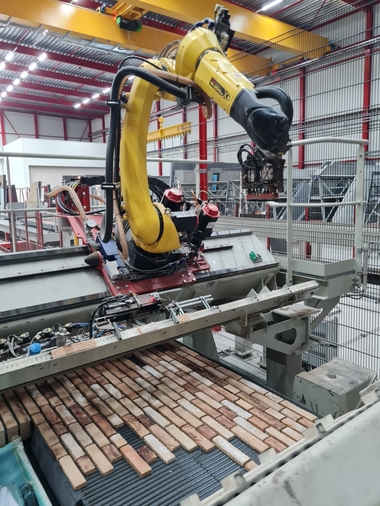
TW: Everyone agrees that the topic of factory prefabrication for construction will play a major role in the market in the future. Because prefabrication can increase the speed and quality of construction and compensate for the shortage of skilled workers. These three reasons are driving interest, and we are well-positioned in the market with our brick-laying system, which we installed in the Netherlands and also showcased
at Ceramitec.
Are there any interested parties?
TW: Yes, we are in talks with several companies. Spaansen, pioneers in this field, are running their system – which we installed three years ago – at full capacity and are requesting a second one. We’re also receiving inquiries from the UK market, as well as the US. These are very large markets for facing brickwork. We’re in contact with a major American manufacturer who has expressed interest.
The beauty of this system for laying brick slips is that it scales very well. You can start with the core component, the laying robot. The logistics and automation surrounding it can be added piece by piece. This minimizes the investment risk.
I have since learned just how high a level of expertise LINGL possesses in robotics, automation technology, and programming. This offers the potential to expand prefabrication beyond bricks. Our vision at LINGL SOLEAD is to be recognized in the market as a partner to the construction and building materials industries, as well as the building supply industry. But LINGL will always retain its expertise in heavy clay products. That is the company’s DNA.