



Review of the IZF Seminar 2025
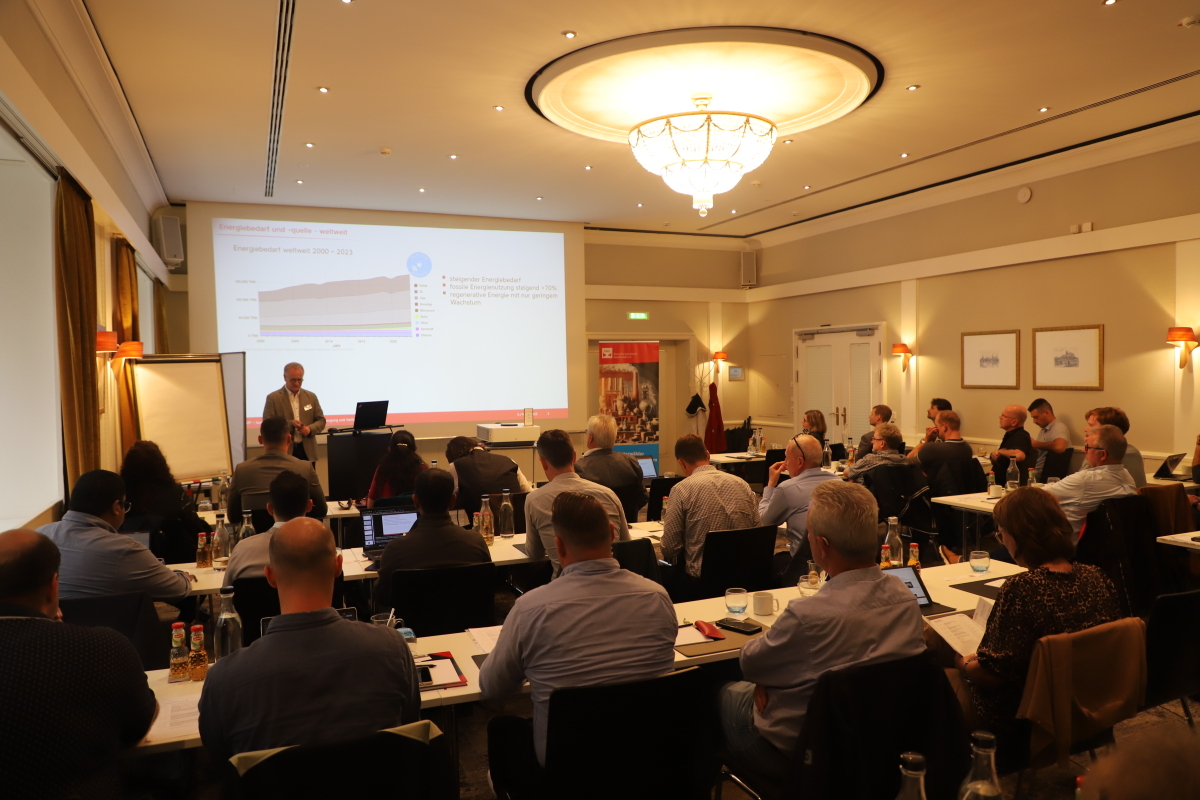


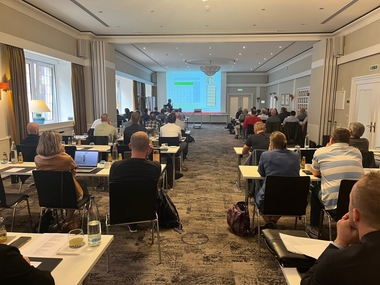
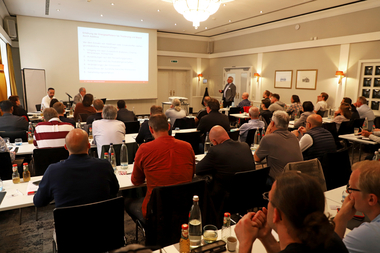
Ways to achieve ‘climate-neutral brick production’ were presented at the seminar held by the Institute for Brick Research Essen e. V. (IZF) on 9 and 10 September 2025. As in previous years, the two-day lecture programme took place in the lecture hall of the Essener Hof in Essen, Germany. Around 50 brickmakers and ceramists attended the lectures. Five guest speakers supported the lecture programme: Timo Vicktorius (QSM Qualitätssicherung und Materialprüfung GmbH), Ralf Wagner (Materialforschungs- und -prüfanstalt Weimar), Jannis Hassler (Research Institute for Glass | Ceramics – FGK Höhr-Grenzhausen), Nisrein Mukattash (RWTH Aachen University) and Baojun Yuan (RPTU Kaiserslautern). Institute Director Dr Rigo Giese and his deputy Eckhard Rimpel guided the audience through the programme.
Day 1 – Regulations, recycling and CO2-neutral process heat
Marius Rimpel explained the changing funding landscape and the resulting current programmes and developments in the first presentation. A key instrument for SMEs, among others, to promote climate neutrality and competitiveness is federal funding for energy and resource efficiency in industry. This is a relevant subsidy for brick manufacturers for transformation steps such as fuel conversion and the development of energy and environmental management systems. For example, the process optimisation of a tunnel kiln with a CO2 emission reduction of around 250 tonnes per year can be subsidised with a maximum of around £546,000. Rimpel also discussed the climate protection agreements established in 2024 and the changes resulting from the amendment that came into force in 2025. Finally, he presented the federal funding programme for industry and climate protection, which is intended to support small and medium-sized industrial enterprises in decarbonisation, particularly electrification, hydrogen use and CO2 capture.
Rimpel concluded his remarks on funding with a second presentation explaining the new obligations on the path to climate neutrality resulting from the requirements for EPDs (Environmental Product Declarations) and ISO 14001. Environmental Product Declarations are standardised, verified environmental information that shows the environmental impact over the entire product life cycle based on a life cycle analysis. They take four environmental indicators into account: CO2, energy, water and waste. EPDs are not yet a legal requirement, but are requested by the market. From 2027, EPDs will be mandatory for many construction products in tenders. Finally, Rimpel explained the practical creation of an EPD with calculation, publication and certification. ISO 14001 is an internationally recognised standard for environmental management systems for the systematic reduction of environmental impact. Its core requirements include the identification of relevant environmental aspects, the setting of targets and programmes, and their review through regular audits. This standard is intended to become the normative basis for an international standard, is already a funding condition in support programmes, and helps to increase efficiency, reduce costs, and contribute to systematic risk management. The following evidence should be available for spot checks: information about the company, management system, total annual energy consumption, identified and proposed measures. According to Rimpel, it makes sense to introduce ISO 14001 in companies because it will become a legal requirement and there are still corresponding support programmes available.
Dipl.-Ing. Sandra Petereit addressed the sustainable use of recycled materials to vary material properties. Resource efficiency is part of the goals and paths set out in the brick industry’s ‘Roadmap to 2050’, the legal requirements of the Resource Efficiency Programme III of 2020 and the National Circular Economy Strategy of 2024, the climate targets of the European Green Deal according to the European Climate Law, last updated in July 2025, and the Clean Industrial Deal package of measures adopted in February 2025. According to the study ‘Bricks – Roadmap to Resource Efficiency’ presented in 2024, German brick manufacturers already use many secondary and recycled raw materials in new production within the scope of their possibilities, but there is still room for improvement in the recycling of used brick materials. A technical data sheet on brick recycling is currently being developed as a guide for brick manufacturers and building material processors, setting out requirements for processed brick material and acceptance criteria for brick production. Petereit made recommendations for increasing the use of recycled material and secondary raw materials. Examples of possible secondary raw materials for the future, whose mechanical and chemical suitability still needs to be tested, include glass powder and glass fibre. Composite materials such as glass fibre-reinforced plastic from dismantled wind turbines have already passed preliminary tests as porosity agents. Another possible porosity agent is shredded coffee capsules, which can also reduce efflorescence. Finally, Petereit pointed out the legal situation regarding when waste becomes a secondary raw material and its use no longer constitutes waste disposal.
Alexander Winkel M.Sc. spoke about the development of a model for determining the brick content of masonry rubble. The model is based on the colour of masonry rubble. This results from the mixture of different coloured brick types and colourless building materials, as demonstrated by an experiment with synthetic masonry rubble. The model is confirmed by an analysis of the chemical composition of the masonry rubble. Substances characteristic of bricks, such as Al2O3, Fe2O3, TiO2 and K2O, are relevant to the colour. The colour and chemical composition allow conclusions to be drawn about the brick content and also the reactivity of the masonry rubble. This is because bricks are the only reactive component in masonry rubble. The brick content also influences the porosity of masonry rubble.
After the lunch break, Winkel discussed the influence of carbonate-free additives and biogenic porosity agents on energy requirements and CO2 emissions during firing. The starting point is the calculated energy requirement for heating 33.9 kg of backing bricks to 950 degrees Celsius. These 28.37 MJ correspond to a gas consumption of 0.88 Nm³, with additional demand arising from the heating of combustion air, supplementary air, exhaust gas and heat losses from the kiln. Two events in the kiln influence the energy requirement: the sample temperature increases due to the combustion of organic matter and decreases during the subsequent decomposition of the carbonates. Both processes release CO2, and the incomplete combustion of organic matter produces CO and smouldering gases, which must be thermally post-combusted. Adding 30 per cent basalt powder reduces CO2 emissions and the decomposition energy of the carbonates by 30 per cent. The calorific value of hydrocarbons increases with the carbon and hydrogen content. The raw material of biochar has an influence on the combustion process.
Dr Rigo Giese spoke about renewable energy – generation and availability. Specifically, he examined the role of hydrogen in the energy and industrial heat transition, focusing on demand and availability. According to the study ‘Total water demand for electrolysis’ by the DVGW Deutscher Verein des Gas- und Wasserfaches e.V. (German Technical and Scientific Association for Gas and Water), the electrolysis of 1 kg of H2 requires 930 – 2,460 kg water. The process requires 12–13 kg, with the rest being used for cooling. Based on the hydrogen demand of the German brick industry at 100% hydogen operation of around 162,000 t/a, this results in a water demand of 515,000,000 t/a or around 0.5 billion m³/a. The installed electrolysis capacity in Germany is 0.16 GW, with a forecast demand of 70 GW by 2050. Current domestic project examples for H2 production, such as RWE – Get H2 Nukleus and EWE Clean Hydrogen Coastline, are in the range of several 100 MV. Hopes are also pinned on future hydrogen sources abroad and imports. Further challenges exist in terms of supply. Most brickworks are not located on the planned hydrogen core network. In all calculated variants, the price of hydrogen is higher than the forecast price of natural gas. The conclusion is that the direct use of electricity from renewable energy sources is more efficient, provided that the process heat can be converted accordingly. This is because the efficiency of direct electrification is 98 per cent, compared to 70 per cent for green hydrogen. The availability and price development of renewable electricity are not yet certain. Decentralised solutions are required for the hydrogen supply, while storage and grid expansion are necessary for electricity and gas transport. The unclear market and political situation make investment decisions difficult.
Erdem Kanbak B.Sc. gave a presentation on the influence of renewable gases on the product quality of bricks – a comparison of ammonia and hydrogen, referring to the IZF projects H2 bricks and NH3 bricks. In the H2 brick project, the work focused on burner modification/design, burner investigations, product properties, tunnel kiln conversion and large-scale testing. Additions of hydrogen to natural gas between 0 and 60 per cent were investigated. The use of hydrogen is technically possible in tunnel kilns. The effects of the change in fuel gas in the kiln are a higher water content in the kiln atmosphere, increased heat transfer through radiation, burnout behaviour of porosity agents and changes in flame length and shape. Effects on the colour and strength of the product were noticeable. For Kanbak’s comments on the NH3 brick project, please see the technical report in ZI 5/25, p. 6ff.
Jannis Hassler discussed changes in the properties of a fireclay mass during firing when hydrogen is used as an energy source. This is based on the results of the third development strand of the H2TO project (see ZI 1/23 p. 42f.): Material and recipe development, which focused on the interaction of a water vapour-containing atmosphere during the sintering of ceramic fireclay and the development of fireclay recipes specifically tailored to hydrogen firing. The FGK was involved in the development of the structure and formulation within the framework of the project. Engels first discussed the basic chemical, mineralogical and thermal characteristics of the fireclay material and then presented the results of the investigation of four different fireclay masses in ceramic firing: (1) Sintering study: phase development in natural gas firing with quenching tests and STA/DTA, (2) Comparative firings of natural gas/hydrogen in the IZF furnace up to 1150 degrees Celsius with microstructure investigations and phase development, (3) Extensions of the furnace investigation at the IZF with a focus on shrinkage, deflection, water absorption, flexural strength, phase development. The conclusion is that hydrogen firing offers potential for reducing the firing temperature while maintaining the properties of the fireclay.
Dipl.-Ing. Eckhard Rimpel discussed the influence of the furnace atmosphere on the refractory material. Various types of damage in suspended ceilings in the furnace can be traced back to sulphur trioxide, potassium oxide and chlorine in the clay or fireclay material, as revealed by chemical analysis. In the case of high alkali contents, modified material mixtures with lower corrosive wear can be used. According to Rimpel, potassium or potassium oxide is the cause of yellow deposits on furnace walls and ceilings. Spalling on the furnace car structure is due to alkali deposits or alkali bursting. Alkali compounds formed as flue gas residues during combustion diffuse into the pores of the refractory material and condense from the gas phase into the solid phase in the temperature range from 650 to 750 degrees Celsius. The increase in volume resulting from the formation of the mineral leucite leads to stresses and cracks, into which alkali compounds diffuse again. The process repeats itself after every temperature change until the entire material flakes off parallel to the surface. Finally, Rimpel reports on investigations of white deposits on RSV (regenerative afterburning) honeycomb bodies and furnace ceilings. These deposits consist of silicon dioxide and silicic acid.
In the final presentation of the first day, Dr. Denny Mathew Alex presented the first part of the ongoing eLITHE project, the conversion, and the results in his presentation entitled Hybrid bogie hearth furnace: operation with gas and electricity. The project objectives include: determining the requirements for a hybrid tunnel furnace, developing the burner, redesigning the pilot plant at the IZF and commissioning it for trials with natural gas, hydrogen and electric heating. Alex described the bogie hearth furnace pilot plant at the IZF and focused in particular on the control and measurement options (furnace atmosphere, combustion air, recirculation air, exhaust gas cooling suction, flue gas) and the difference between the old and current status: the conversion of the heating elements, the installation of the circulation systems and various sensors, a reference test and the retrofitting with electric heating elements. Alex announced that the next step would be to start hybrid operation.
Following the presentations, Rigo Giese invited attendees to a cosy get-together with a buffet and guided tours of the IZF premises in Essen-Kray, as in previous years.
Day 2 – Quality assurance, electrification of thermal processes and bricks as a building material
In the first presentation on the second day, PÜZ (testing, monitoring and certification) site manager M. Sc. Timo Vicktorius asked the question Is self-monitoring important? and discussed the results of external monitoring in comparison to answer it. In doing so, he pointed out methodological pitfalls. If, for example, the area of the hollow in the brick is not taken into account, the compressive strength value will be significantly underestimated. When determining the proportion of holes, methodological differences between sand filling (ignores gaps in tongue and groove and plaster grooves) and underwater weighing (records all gaps, grooves and pores) must be taken into account. When determining the web thickness, dragon’s teeth can distort the result. Vicktorius also addressed the measurement rules for paving bricks and clinker bricks as well as roof tiles and brick slips, explaining them with test examples. He also explained the requirements for immersion, contact, suction and frost testing of clay bricks. Finally, he discussed current and upcoming acquis processes in which national requirements for construction products are to be harmonised into a single European standard.
Dr Ralf Wagner (MFPA) spoke about electrification in the brick industry using microwave technology. He contrasted the advantages (volumetric heating, easily controllable energy input, rapid product heating with higher drying speeds possible, contactless energy transfer, no heating of the process room necessary, temperature gradient from inside to outside) with the disadvantages (high investment costs, conversion of existing long-life systems, process changes, safety concept required, creation of hot and cold spots). Wagner explained in detail the physics of energy input (see also ZI 3/22 p. 8ff. and ZI 5/22 p. 14ff.). Drying with microwaves is particularly well suited for absorbent, porous materials, as mass transport (water) is easily possible in these materials. For an optimised drying process, Wagner proposes a single-layer microwave drying tunnel 7 metres in length directly after the cutter (heating: 50–100 °C; energy: approx. 100 kW; investment costs: approx. €400–500 thousand). The firing of bricks with microwaves, on the other hand, is still the subject of further research. Process development requires knowledge of: 1. Permittivity at high temperatures, 2. Temperature distribution within the sample, 3. Measurement technology for control, 4. Analysis of the interaction of microwaves with the material at high temperatures in a suitable facility.
Marius Rimpel presented another path to electrification and the subject of the ELuZi research project in his lecture Designing electrification differently – hot air generators for the ceramic firing process. The initial problem is the provision of climate-neutral high-temperature industrial heat without combustion gases such as green hydrogen or biogas/methane. A purely electrical heat source lacks the essential heat transfer component of convection. To avoid the resulting uneven heat input, existing technology only offers economically and technically complex circulation. Electric process gas heaters can provide an active impulse input. Available process gas heaters based on ceramic heating elements offer 1,100 degrees Celsius in the 4–60 kW range. The Eluzi project aims to develop and build a 250 kW electric air heater that delivers highly heated air up to 1,300 degrees Celsius and is to be used in a tunnel kiln at Jacobi Dachziegel instead of a burner group. This should enable the electrification and decarbonisation of the brick industry without losing the filling geometry. The first 50 kW air heater prototype, developed by Heatrix, is currently being tested at the IZF in a test furnace.
Akash Nagaraj spoke about optimising brick surfaces to improve the urban climate and the energy efficiency of buildings. The aim is, among other things, to adapt the radiative properties of coarse ceramic component surfaces, reduce heat island effects and lower building energy requirements (less cooling). Heat islands, areas of higher temperature (1–7 degrees during the day, 2–5 degrees at night), occur when buildings in urban areas absorb and emit solar heat. The material properties and thickness of building materials, the height and density of buildings, and roof pitch all contribute to this effect. The results of a parametric study using ENVIMET (software for simulating the microclimate) with, among other things, facing bricks, roof tiles, paving bricks and facing bricks show that the air temperature depends primarily on the reflectivity of the building material. IR reflection can be increased by structures and IR-reflective coatings.
Alexander Winkel provided information on the fire resistance of clay plaster. Clay plaster is a mixture of small amounts of clay minerals as a binder and a high proportion of silty-sandy components. Additives are mixed in depending on the type of clay minerals and the requirements (top coat, base coat), including fibres, animal hair or crushed, natural wood. The exact composition has a major influence on the fire protection properties. The requirements and application of clay plaster are summarised in DIN 18947. The advantageous properties of clay plaster include: diffusion-open, sorption and heat storage capacity, non-combustible, free of harmful substances, recyclable, regionally available. This makes the building material suitable for regulating indoor climate, preventing mould, buffering temperature fluctuations, etc. Winkel reported on an experimental comparison of clay plaster and lime plaster, each 15 mm thick, in the event of a fire. Clay plaster expanded more than the bricks underneath, this compressive stress led to spalling in the plaster. Lime plaster, on the other hand, contracts and the tensile stress leads to cracking. Clay plaster walls pass the 90-minute fire test.
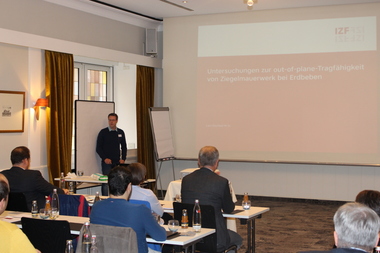
Nisrein Mukattash presented a new approach to estimating the drift capacity of masonry panels made of brickwork, taking into account building interaction. This is necessary in light of the requirements for masonry structures, the goal of better utilisation of structural reserves, the development of practical modern seismic design concepts, the consideration of load-bearing and deformation capacity, and innovations in deformation-based design with the imminent introduction of the 2nd generation of Eurocode 8 with new drift capacity for individual walls and capacity curves for buildings. Mukattash described the development starting from the 1st generation of Eurocodes. However, a continuous approach and important parameters are still lacking. She presented a new shear wall database, a new database tool and a new approach to drift capacities. This results in reliable drift capacities, realistic stability verifications, greater safety and cost-effectiveness in construction, and an improvement in shear design concepts.
In the final presentation of the IZF seminar, Baojun Yuan M.Sc. discussed the basics of energy-based earthquake design for masonry structures. The starting point is that common normative design methods for earthquake cases are highly simplified and provide unreliable results, leading to conservative and uneconomical designs. Among other things, dynamic processes in masonry structures are not sufficiently taken into account. To improve this, the fundamentals for energy- and deformation-based seismic design of masonry structures are to be established. In doing so, dynamic effects are to be better taken into account in the design. Yuan described the work carried out at the University of Kaiserslautern and the IZF and the results achieved. The design model determined in this way is more economical and practical than existing models.
Dr Giese thanked the participants for their interest and invited them to a concluding lunch and the next IZF seminar on 29 and 30 September 2026.