



Slight recovery for the Dutch brick industry in 2025
Housing development
According to the Dutch national statistics office Centraal Bureau voor de Statistiek (CBS), the number of new homes completed in 2025 fell for the third year running. The net figure (comprising new builds, demolitions and conversions/reallocation of dwellings) stood at just over 70,000, of which 69,200 were new builds. This is roughly in line with the volume of new-builds in 2024 and is significantly below the national construction target of 100,000 new homes per year.
Data from the CBS also showed that planning permission was granted for almost 86,000 new-build homes in 2025. In 2024, the figure stood at almost 94,000 homes. Although more planning permissions were granted in the last two years than in the five years prior to that, this does not immediately lead to more new-build homes in the short term. After all, it is taking increasingly longer for new homes to be completed once planning permission has been granted.
Overall, pressure on the housing market remains as high as ever. This is due to the unresolved nitrogen issue, protracted approval procedures, declining investment from capital investors and staff shortages. In 2025, network overloads and a looming shortage of water connections were added to the mix.
Brick
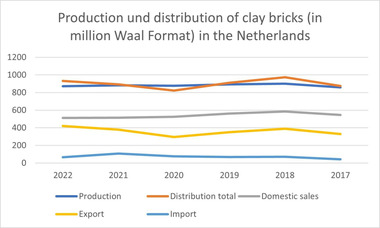
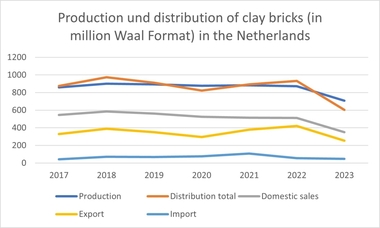
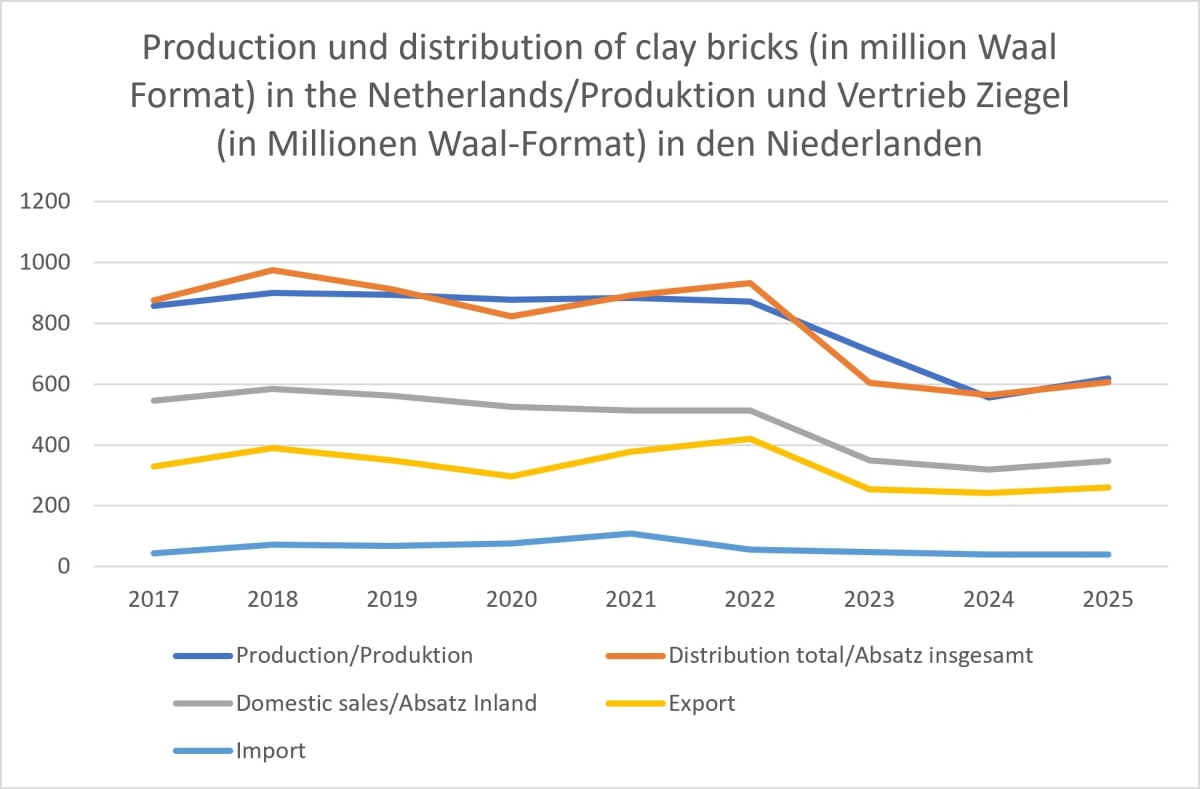
2025 was a positive year for the Dutch brick industry. Total sales (plus 8 percent), domestic sales (plus 9 percent) and exports (plus 7 percent) all rose. Production also picked up (plus 12 percent). Almost 43 percent of exports went abroad, primarily to the UK. It should be noted that these positive figures follow years of sharp decline. Sales and production of bricks reached historic lows in 2023 and 2024. Against this backdrop, sales growth of 8 percent is modest in absolute terms.
Paving bricks
The market for paving bricks showed a further recovery in 2025. The market values the circular economy characteristics of ceramic paving bricks and their exceptionally long service life of 135 years on average. This makes them a particularly sustainable product. Fired clinker bricks are being used more and more frequently, including in climate-resilient systems. The slim paving brick (dematerialisation) has a positive impact on reducing the environmental cost indicator and broadens the range of options available to builders.
Ceramic roof tiles
In 2025, demand from new-build projects stabilised, with a cautious recovery in the wake of rising residential construction output. The refurbishment market remains the stable driving force; demand for high-quality roof tiles for the repair and sustainability optimisation of roofs continues unabated. A key factor in 2025 was the breakthrough in integrated roofing solutions, in which ceramic roof tiles are combined with solar energy systems, both technically and aesthetically.
Ceramic tiles
In 2025, a slight improvement was recorded in new residential construction. The focus was on the refurbishment sector, where sales of ceramic tiles for residential construction increased. Sales in commercial construction came under pressure. The importance of sustainability is growing.
Outlook
At the start of 2026, the Economic Institute for the Construction Industry (Economisch Instituut voor de Bouw EIB) was optimistic about residential construction output in the coming years. Given the rise in the number of building permits granted in 2024 and 2025, it even considers growth of 25 percent within two years to be possible.
The geopolitical consequences of the unexpected conflict in the Middle East are already making these and other forecasts seem outdated. The Dutch Central Bank (De Nederlandsche Bank) has analysed the consequences across various scenarios. In all cases, there will be significant upward pressure on the prices of building materials and, consequently, on property prices. This is not a favourable outlook either for those seeking accommodation or for the necessary pace of construction.