



ELECTRIFICATION AND ENERGY INTEGRATION IN INDUSTRIAL KILN ENGINEERING
Three decades of continuous process development at Keramischer OFENBAU

Rising energy and emission costs are shaping investment decisions in the heavy clay industry. Alongside kiln type and plant design, two key questions now dominate: which energy source is most economical for a specific location, gas or electricity, and how can efficiency potential be unlocked without compromising production stability? Keramischer OFENBAU addresses these challenges with a clear technological strategy. The entire portfolio is available with either gas or electric heating, complemented by the ongoing development of hydrogen-ready concepts and the EnerViT modernisation approach for existing plants.
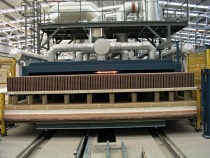
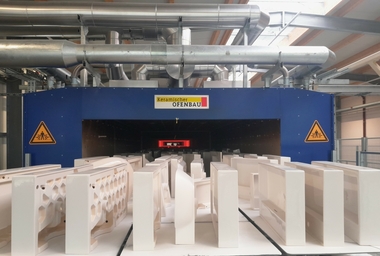
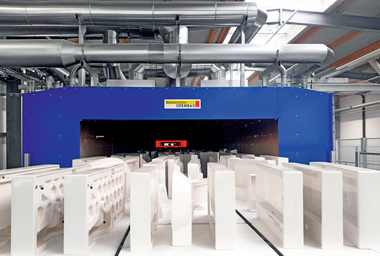
Electrification is a relevant expansion of economically viable options for ceramic production. The optimal heating solution depends on local conditions such as grid capacity, on-site power generation, regulatory frameworks and production requirements. The decisive factor is therefore the interaction between process design, energy supply and operating costs. Electric kilns enable highly precise and immediately responsive power control, allowing accurate execution of thermal process steps. Gas-fired systems offer high power density and robust operating stability in continuous large-scale production. In both cases, real energy efficiency results from the integrated design of heat transfer, exhaust management and control strategy.
In continuous kilns in particular, energy efficiency is closely linked to process stability, as minor deviations can accumulate along long kiln sections. Precisely coordinated control systems therefore reduce energy consumption while simultaneously improving reproducibility and product quality. A recent addition to the portfolio is the electric shuttle kiln eHWO, up to six metres wide, designed for discontinuous processes with varying formats or smaller batch sizes. Key advantages include flexibility, reproducible firing curves and stable temperature control. Operation can also be aligned with electricity availability, for example from on-site renewable generation. Modernisation of existing plants is gaining increasing importance. With the EnerViT system, Keramischer OFENBAU combines pulse burner technology with advanced control engineering to enable demand-oriented energy input. Energy savings of up to 50% can be achieved independently of the original kiln manufacturer.
For heavy clay producers, the discussion is therefore shifting away from “gas or electricity” towards measurable efficiency and sustainable economic performance. With both electric and gas-fired solutions, alongside technology-driven retrofit concepts, Keramischer OFENBAU focuses on delivering maximum process stability with minimised energy consumption, in both new installations and existing plants.