



Complete systems for the brick industry from Wassmer


The Wassmer Group develops solutions tailored to customer requirements regarding the product, space constraints, performance, and quality. In most business sectors worldwide, there is a growing demand for greater flexibility in machinery and systems. This is because adapting them to customer requirements and the product involves a wide range of factors and always requires a custom design. The scope ranges from unsorted individual tasks to larger quantities with many different formats.
Wassmer offers the complete handling solution for the brick industry, including loading and unloading, transferring, formatting, bundling, palletizing, packaging, and integration into existing systems.
In the building materials industry, processes such as sawing, grinding, and slot milling are not only automated. The systems also take special technical and aesthetic requirements into account and integrate them into the processing.
A complete system can operate as a standalone unit, serve as a bypass solution, or be integrated into an existing line.
Wassmer installed the system described below at the Goriške Opekarne d.d. brickworks in Renče, Slovenia, starting from the tunnel kiln cars. It expands production to include a grinding system and replaces the old system up to the packaging stage. In this case, two specific requirements had to be taken into account. First, the system was adapted to the limited available space, and second, to specific requirements regarding the packaging of the various formats.
Process and System Description
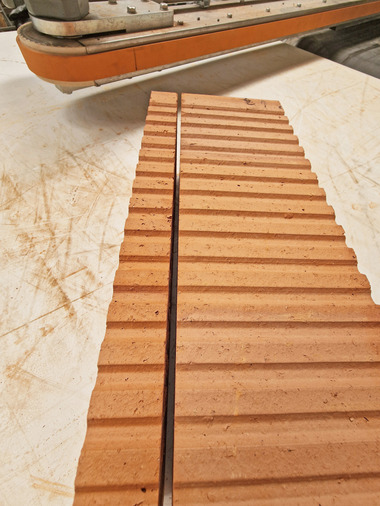
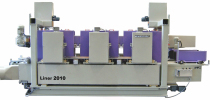
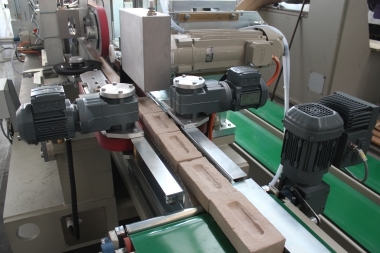
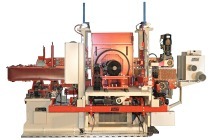
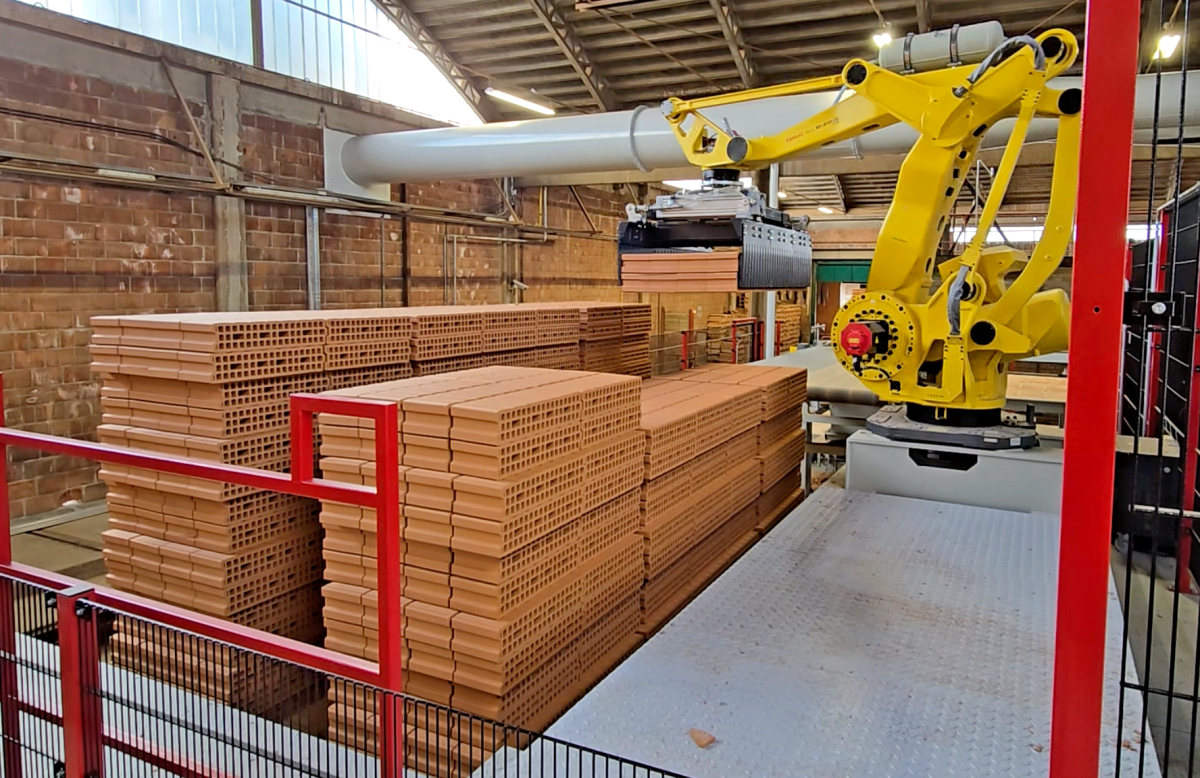
A robot unloads the tunnel kiln cars and places the bricks on the conveyor belt; the layers are then separated into individual rows. These rows are subsequently fed into the grinding machine, where both single-layer and double-layer processing is possible.
The grinding process takes place in two stages; an additional third grinding stage can be integrated later as needed.
After grinding, the processed rows are reformatted into complete layers using push-off devices. These layers are then bundled and secured with strapping.
A robot then handles the palletizing of the finished layers. The pallets required for this are first automatically retrieved from a pallet magazine by another robot and placed on the transport system.
The fully loaded pallet is then wrapped by an automatic stretch-wrapping machine. Finally, a label containing the relevant production and product data is applied to the side.