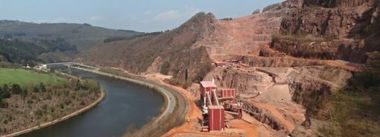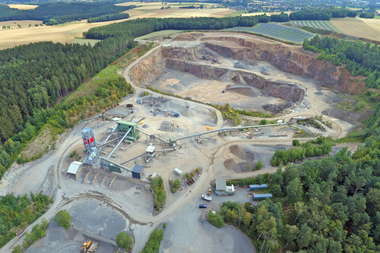




Modern raw materials for the Brick Industry Part 5: Greywacke from the High-Tech Seljestokken Quarry
 STEER AS
 STEER AS
 STEER AS
![»4a: Simplified diagram of the Caledonian orogeny from [1]](https://www.zi-online.info/imgs/2/3/7/7/4/3/4/004a_Kaledonische__Gebirgsbildung-13fdc3d6df0c3e83.jpeg) Martin Meschede
Martin Meschede
 Martin Meschede
 STEER AS
 Dr. Krakow
 Dr. Krakow
 Dr. Krakow
The raw materials industry must explore new avenues − otherwise, it cannot survive. The fully AI-controlled Seljestokken quarry on the coast of southwestern Norway is truly groundbreaking. As a secondary raw material from processing, clay-rich rock flour is also extracted for the brick industry.
1 Geological Context and Location
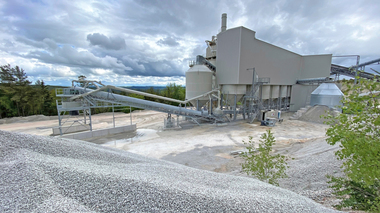
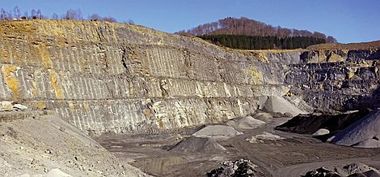
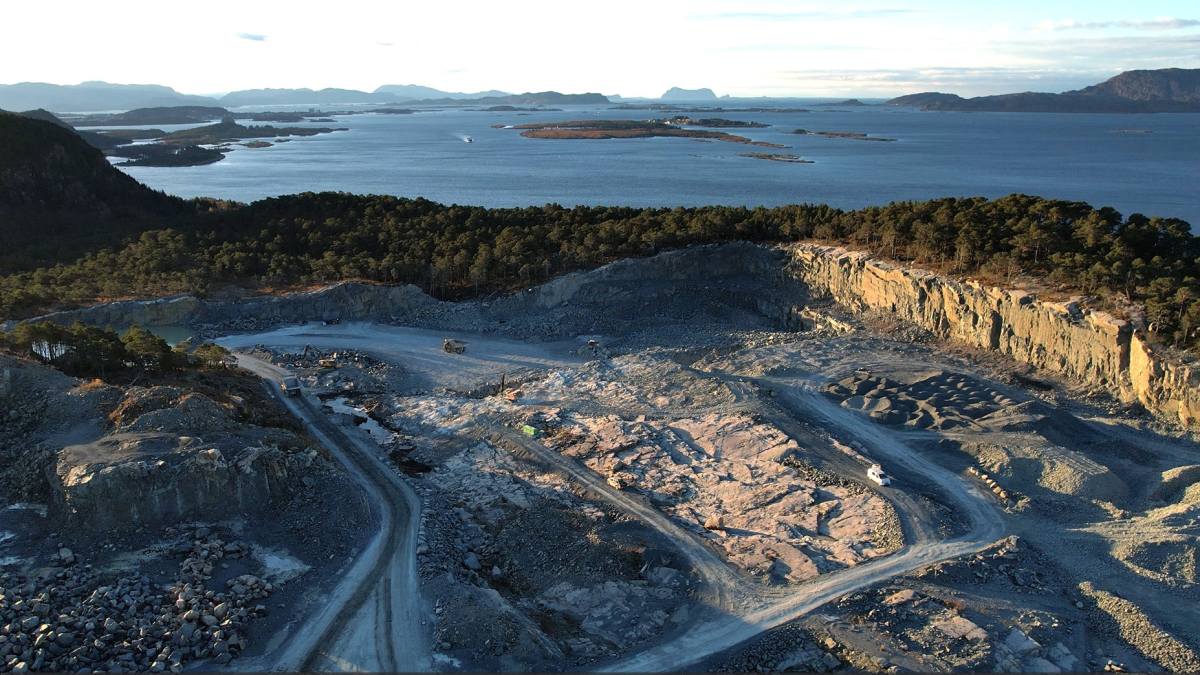
Norway is one of the leading producers of natural stone in Europe. The industry is highly specialized and export-oriented. Major quarrying regions are located in western and southern Norway (»1). Gneisses, granites, and metamorphosed greywackes are primarily extracted here. Large quarries have direct access to the sea and can load ships directly without pre-shipment costs. This is also the case for the Seljestokken quarry north of Bergen.
The quarry is operated by DC Industrial NV-SA / Group De Cloedt using driverless dump trucks. The trucks shuttle autonomously between the quarry face and the primary crusher. Control is handled either by the excavator operator or the operator in the office container. A groundbreaking transport technology offering high performance and low costs (»2 & »3).
Geotectonically, the Norwegian coastal region is characterized by the Caledonian Mountains, which are welded as a major tectonic unit to the Baltic Craton. Overall, this was a highly complex mountain-building process spanning from the Ordovician to the Devonian, with its main phase occurring in the Silurian 450 million years ago. The collision of the ancient continents Avalonia, Laurentia, and Baltica led to the formation of the supercontinent Laurussia (»4a, »4b). A massive high mountain range emerged in the collision zone, but over the course of hundreds of millions of years, it was largely eroded away. What remained was the Scandinavian mountain range with a crystalline basement. The landscape received its final shaping during the Quaternary ice ages. Mighty glaciers carved out trough valleys and fjords up to 200 kilometers long into the bedrock (»5).
2 Mineralogical and Chemical Composition
Greywacke is a clastic sedimentary rock composed primarily of phyllosilicates, quartz, feldspars, and rock fragments. Among the phyllosilicates/clay minerals, dioctahedral and/or trioctahedral micas predominate over chlorite. Carbonates in the form of calcite and dolomite may occur in minor amounts. Greywackes are also referred to as impure or poorly sorted sandstones. They represent typical flysch sediments and form during orogenesis from submarine turbidity currents.
The Seljestokken rock powder covers grain sizes ranging from clay to medium sand. The grain size maximum lies in the medium grain range of d = 0.002 – 0.06 mm. The fine grain fraction d < 0.002 mm amounts to 8 mass % (»6). Mineralogically, the Seljestokken rock flour is typically dominated by phyllosilicates, quartz, and feldspars, with the phyllosilicate content at 38 mass %. Due to diagenetic and early metamorphic alteration, kaolinite and intra-crystalline swelling phases are completely absent (»Table 1).
Chemically, silicon and aluminum clearly dominate over all other elements. Significant amounts of alkaline and alkaline earth fluxes are primarily contributed by the micas and feldspars. Iron does not occur as a separate mineral phase but is incorporated into the crystal lattice of the clay minerals at 5.27 mass %. Interfering elements such as sulfur and organic matter are minimal and lie within the RFA detection limit (»Table 2).
3 Ceramic Technological Characteristics
Seljestokken rock flour is classified as a particularly energy- and resource-efficient plasticizer (»Table 3). Due to its optimal particle size, the material does not require energy-intensive grinding but only needs to be homogeneously mixed with the other batch components. The material is ideally suited to substitute traditional shale clays and thereby reduce the consumption of primary raw materials.
As a fine-grained additive, the material is universally applicable in the brick industry. Within the temperature range of 900 – 1,050 °C, the material is characterized by a very broad and stable sintering range with high porosity. This improves the degassing of bodies with a high organic carbon content. At higher firing temperatures, rapid dense firing occurs. The firing colors vary depending on the firing temperature, ranging from light yellow to dark brown (»7).
4 Quantity Availability and Concluding Remarks
The Seljestokken quarry has large geological reserves of greywacke and mining permits valid for decades. It also has direct access to the sea and its own boat dock with no pre-shipment costs (»8).
Acknowledgments and Image Credits: We thank Managing Director Njål Gjermundshau of STEER AS in Oslo, Norway, for his kind support and for providing the images (Photos 1, 2, 3, 5).